




Your money transfer to India bounced and your net banking locked up, only for the bank to inform you that your account had gone dormant.
Table Of Content
- When does an NRI account go inactive or dormant?
- What you lose when the account goes dormant
- How to keep your NRE/NRO account active from the USA
- How to reactivate a dormant NRI account from the USA, step by step
- Step 1 — Confirm the account is actually dormant
- Step 2 — Download the reactivation or re-KYC form
- Step 3 — Gather and self-attest your documents
- Step 4 — Get them notarised
- Step 5 — Submit online, by secure message, or by post
- Step 6 — Make a small transaction to fully reactivate
- Documents a US-based NRI needs
- How long reactivation takes and what to expect
- FAQ
- Keep it simple
If this has happened to you, you are not alone. It is one of the most common problems for US-based NRIs. This guide covers two things: how to keep your NRI account from going dormant in the first place, and how to fix it from the USA, without booking a flight to India.
Quick Answer
A dormant NRI account happens when there are no customer transactions for a set period. To prevent it, make one real debit or credit each year. To reactivate from the USA, fill out the bank’s reactivation and re-KYC (Know Your Customer) form and submit it with your passport, visa or green card, US address proof, a FATCA declaration, and your SSN or ITIN.
When does an NRI account go inactive or dormant?
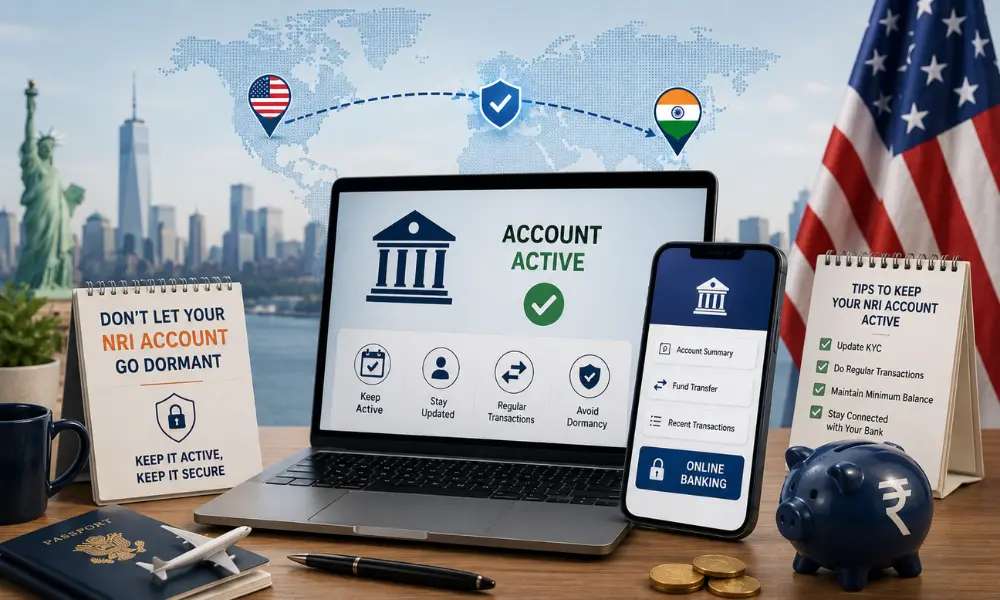
In most Indian banks if there is no customer-driven transaction in your account for one year, it is marked inactive. If that stretches to two years, it becomes dormant, or “inoperative”. This rule was set by the RBI in a circular dated 1st January 2024, and it applies per account, not per customer. So if you have three NRI accounts and only use one of them, the other two can quietly slip into dormant status while the third stays fine.
Here is the trap many NRIs fall into. Interest credited by the bank and charges like fees or penalties do not count as a real transaction, because these are started by the bank, not by you. Your Non-Resident External (NRE) account can sit there earning interest for years and still be marked dormant, simply because you never personally sent or moved money through it.
A real transaction means something you started. A fund transfer, an ATM withdrawal, or a payment counts. Just logging in doesn’t reset the inactivity clock. Only an actual debit or credit does.
What you lose when the account goes dormant
In a dormant account transfers stop working in both directions. You cannot send money in, and you cannot pull money out. Online banking gets locked, your debit card will not renew when it expires, and chequebook requests are also blocked until the account is active again.
You can lose the ability to update your address, phone number, or email on a dormant account. That means if your details change while you are in the USA, you cannot fix them until the account is reactivated first, which can turn a small problem into a longer chase.
But it can be fixed by these known sets of steps, and once you know the US-specific paperwork it asks for.
How to keep your NRE/NRO account active from the USA
Make at least one real debit or credit in each account, once a year. Even a small transfer between your own Non-Resident External (NRE) and Non-Resident Ordinary (NRO) accounts, or a token remittance to family, is enough.
From the USA, this is easy to manage without visiting a branch:
- Use your bank’s net banking site or mobile app to make a small self-transfer.
- Send a token remittance to a family member in India through the app.
- Set up an annual standing instruction so a small transfer happens automatically every year, and you never have to remember it yourself.
Keep your KYC details and contact information current too. Your US address, US phone number, and passport or visa validity should always match what the bank has on file.
Finally, set a yearly calendar reminder to check your accounts. RBI guidelines require banks to notify you before an account goes dormant, but only if your registered email and phone are up to date.
How to reactivate a dormant NRI account from the USA, step by step
If your account has already gone dormant, here is the exact sequence to follow to reactivate an NRI account abroad:
Step 1 — Confirm the account is actually dormant
Log in to net banking or call your bank’s NRI customer care line. Ask them directly whether the account is inactive or fully dormant.
Step 2 — Download the reactivation or re-KYC form
Go to your bank’s NRI services page. Most major banks, including ICICI, HDFC, SBI, and Kotak, list these forms there. You can also request the form by writing to the bank’s NRI customer care email.
Step 3 — Gather and self-attest your documents
Collect your passport, visa or green card, PAN, and a recent photo. Sign and self-attest each copy, and make sure every account holder on a joint account signs their own set.
Step 4 — Get them notarised
Get your documents notarised at a US notary public, or attested at your nearest Indian consulate if the bank asks for that instead. Confirm whether your bank accepts a US notary stamp or requires Indian consulate attestation before you get documents notarised.
Step 5 — Submit online, by secure message, or by post
Many banks now accept the form and scanned documents through net banking or a secure message system. If your bank requires original documents rather than scans, mail them by post, and build in extra time, especially for international post.
Step 6 — Make a small transaction to fully reactivate
Once the bank confirms your documents are accepted, make a small transfer or deposit. This final transaction is what switches the account back to active status.
Documents a US-based NRI needs
Requirements vary slightly by bank, so always confirm the exact list with yours before you start. Here’s a general list:
| Document | Why it’s needed |
| Reactivation and re-KYC form | Signed by all account holders on the account |
| Valid passport | Standard identity proof for every NRI account |
| Visa or US residence proof | Green card, H-1B approval, or similar US status proof |
| Recent photo | Identification |
| PAN or Form 60 | Required for Indian tax and KYC purposes |
Some banks also accept a valid driving licence or Aadhaar card as secondary identity proof. Confirm with your bank which secondary proofs they accept.
Requirements vary slightly by bank, so always confirm the exact list with yours before you start.
US-Specific documents:
| Document | Why it’s needed |
| FATCA declaration/ W-9 | Confirms your US tax status as a US person to the bank |
| US Tax identification Number | Your Social Security Number or ITIN, needed for FATCA reporting |
| US address proof | A recent US utility bill, bank statement, or a lease agreement |
Self-attest every copy. Sign and date each page. Joint-account holders must each sign their own set.
How long reactivation takes and what to expect

Many banks aim to process reactivation within 24 to 48 hours once documents are verified, though timelines vary, so check with your bank. That estimate covers only the last part of the timeline.
The real wait usually comes from gathering your documents, getting them notarised, and posting them if the bank needs physical copies. Start the process as early as you can, especially if mailing is involved.
Once the bank confirms everything is in order, you will get a confirmation message. Make your small reactivation transaction soon after, and your account should be fully active again.
FAQ
Yes. Most major Indian banks now support remote reactivation for NRIs. You fill out the reactivation form, notarise your documents in the USA, and submit them online, by secure message, or by post, without needing to visit a branch in person.
No. Interest credits and bank charges are started by the bank, not by you, so they do not count toward keeping the account active.
You will typically need a completed FATCA declaration or Form W-9, your US Tax Identification Number (SSN or ITIN), and proof of your US address, such as a recent utility bill or bank statement.
Most banks do not charge a fee simply for reactivation. Policies on any limits right after reactivation can vary by bank, so it is worth checking your bank’s specific terms before you begin.
Keep it simple
One transaction a year is all it takes to keep a dormant NRI account from ever becoming a problem. And if it already has, reactivating from the USA just means a form, updated KYC, and a short list of US-specific documents like your FATCA declaration and US address proof. No flight to India needed.
Check your account status today, and set that yearly reminder. If you’re thinking about opening or upgrading an NRI account, that’s worth exploring too.