




How to Apply for a PAN Card from the USA: Step-by-Step Application
You can apply for a PAN card from the USA without travelling to India. Fill in the application on the Protean (formerly NSDL) or UTIITSL portal, then post your signed acknowledgement and document copies to the processing centre. Indian passport holders use Form 93; OCI, PIO and foreign-passport holders use Form 95. Choose the form by citizenship, not by where you live.


If you live in the US and collect rent from an Indian flat, sell inherited land, invest in Indian mutual funds, open an NRO or NRE account or file an Indian tax return, you need a PAN. Many people assume that means flying to India. It doesn’t. This guide shows you how to apply for PAN card from USA, including a change many older guides miss: Forms 49A and 49AA were retired on 1 April 2026. We cover who needs a PAN, which form to use, which documents work for US residents, current fees and realistic delivery times.
Table Of Content
- What Is a PAN and Your PAN Number?
- Do NRIs in the USA Need a PAN Card?
- Which Form Do You Fill: Form 93 vs Form 95 (Formerly 49A vs 49AA)
- Documents Required (From the USA)
- How to Apply for a PAN Card From the USA: Step by Step
- Fees, Processing Time, and Delivery to the USA
- Common Mistakes and When to Get Help
- Frequently Asked Questions
- Can I apply for a PAN card from the USA without visiting India?+
- How long does it take to get a PAN card delivered to the US?+
- What is the difference between an e-PAN and a physical PAN card?+
- Can a US citizen of Indian origin (OCI) apply for a PAN?+
- Do I need to update my PAN status if I move back to India?+
- How do I track my PAN application from the USA?+
- Is PAN the same as Aadhaar, and do NRIs need both?+
What Is a PAN and Your PAN Number?
A Permanent Account Number (PAN) is a ten-character alphanumeric ID issued by India’s Income Tax Department. Think of it as the Indian counterpart to a Social Security number for tax purposes. Your PAN number follows the pattern AAAAA9999A: five letters, four digits and a final letter. For an individual the fourth letter is P, and the fifth is usually the first letter of your surname. It is issued once, stays with you for life and doesn’t change when you move countries.
For someone living in the USA, a PAN is typically needed to:
- file an Indian income tax return
- invest in mutual funds or open a demat or trading account
- buy or sell property above the reporting limits
- open and operate an NRO or NRE account
- avoid higher tax deducted at source, which can apply when you can’t quote a PAN
Do NRIs in the USA Need a PAN Card?
A PAN card for NRIs is needed only when you have a financial link to India, but the list of triggers is longer than most people expect. NRIs (Indian citizens living abroad), OCI and PIO cardholders, and foreign nationals who transact in India can all apply.
Common triggers for US-based applicants:
- rent, interest, dividends or capital gains from India
- buying, selling or inheriting property
- investing in Indian shares or mutual funds
- opening an NRE or NRO account
Citizenship decides which form you use. An engineer in the US on an Indian passport is an NRI and uses Form 93. A US citizen of Indian origin holding an OCI card is a foreign citizen for PAN purposes and uses Form 95.
Check whether you already have a PAN before you apply. Holding more than one is not allowed, so if you got one while studying or working in India, verify its status and update it instead of applying again.
Which Form Do You Fill: Form 93 vs Form 95 (Formerly 49A vs 49AA)
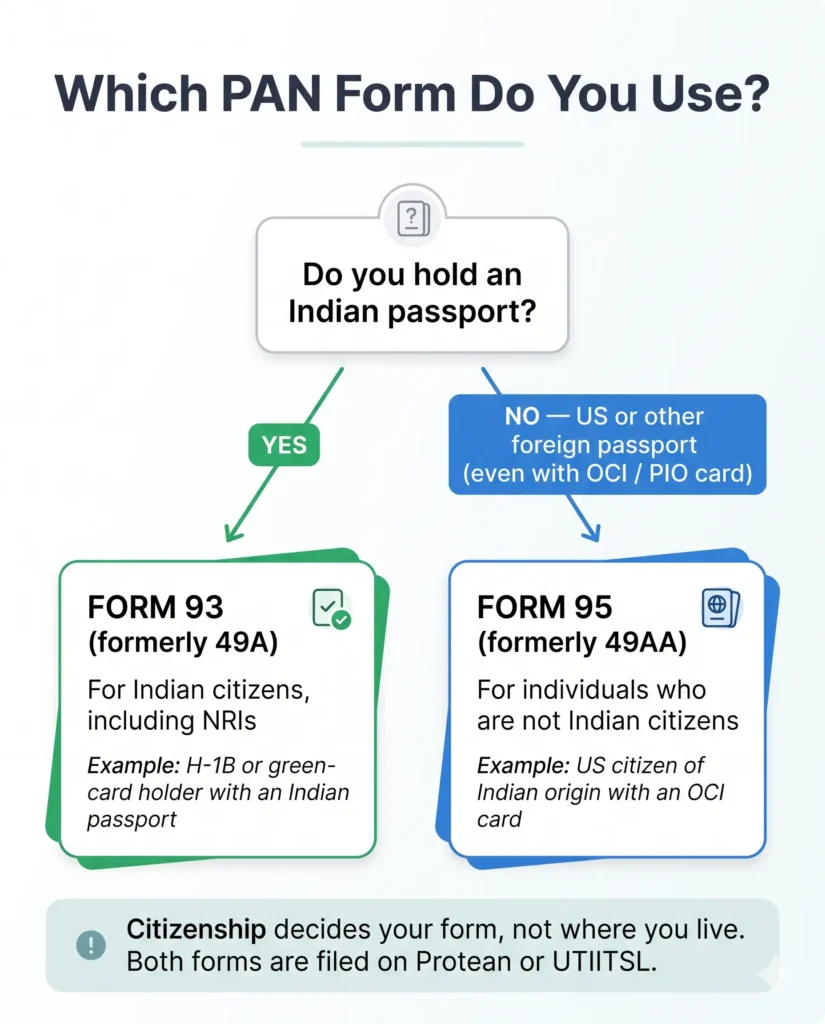
The PAN card application form depends on citizenship, not residence. Under the Income-tax Rules, 2026, the old forms were discontinued after 31 March 2026. Form 93 replaced 49A for Indian citizens, and Form 95 replaced 49AA for individuals who aren’t Indian citizens. The department describes Form 93 as for “Indian Citizen, NRI & RNOR”. Both forms are filed on Protean or UTIITSL.
The most common US-applicant mistake is picking the wrong side of the line: a US citizen with an OCI card choosing Form 93, or an NRI with an Indian passport choosing Form 95. A deficient application is treated as invalid and has to be refiled.
| Factor | Form 93 (formerly 49A) | Form 95 (formerly 49AA) |
| Who it is for | Individuals who are Indian citizens, including NRIs | Individuals who are not Indian citizens |
| Citizenship | Indian passport | US or other foreign passport, plus OCI or PIO card if held |
| Example US applicant | H-1B or green-card holder who still holds an Indian passport | US citizen of Indian origin with an OCI card |
| Mandatory identifiers | Passport number and TIN for non-resident citizens | TIN and proof of date of birth |
| Portal | Protean or UTIITSL | Protean or UTIITSL |
Sources: the department’s PAN page and FAQs and its guidance note on Forms 93 to 96.
Documents Required (From the USA)
Every applicant submits proof of identity, proof of address and proof of date of birth under Rule 158 of the Income-tax Rules, 2026. The official lists are long, but a US applicant can usually cover all three with a passport and one US bank statement.
| Document type | Accepted examples | Notes for US applicants |
| Proof of identity | Form 93: Indian passport. Form 95: passport, OCI card or PIO card | Spell your name identically on every document. Initials aren’t allowed in the name field. |
| Proof of address | Form 93: bank statement from your country of residence or an NRE statement. Form 95: passport, OCI or PIO card, US bank statement or NRE statement | A US bank statement dated within the last three months, showing the address you enter on the form, is the safest choice. |
| Proof of date of birth | Form 93: Indian passport or birth certificate. Form 95: passport, OCI or PIO card, or birth certificate | Aadhaar no longer counts as proof of birth. A US birth certificate needs an apostille or consular attestation. |
| Photograph | Recent photo, 5 cm x 3.5 cm | The size increased from 5 cm x 2.5 cm in April 2026. |
| Signature | Signed at the bottom of the form only | Sign inside the box, never across your photo. |
Attestation. Form 95 accepts documents attested by an apostille or by an Indian embassy, high commission or consulate. India is a Hague Apostille Convention member, and US state-issued documents typically get their apostille from the issuing state’s Secretary of State. The State Department’s authentications page explains the process. Older guides also allowed a bank manager to attest a statement, so check the portal’s checklist for what it asks today.
Your TIN. US residents typically use an SSN or ITIN, both of which the IRS lists as taxpayer identification numbers.
US delivery address. The form lets you choose your residence or office address for communication, so the card can come to your US address.
How to Apply for a PAN Card From the USA: Step by Step
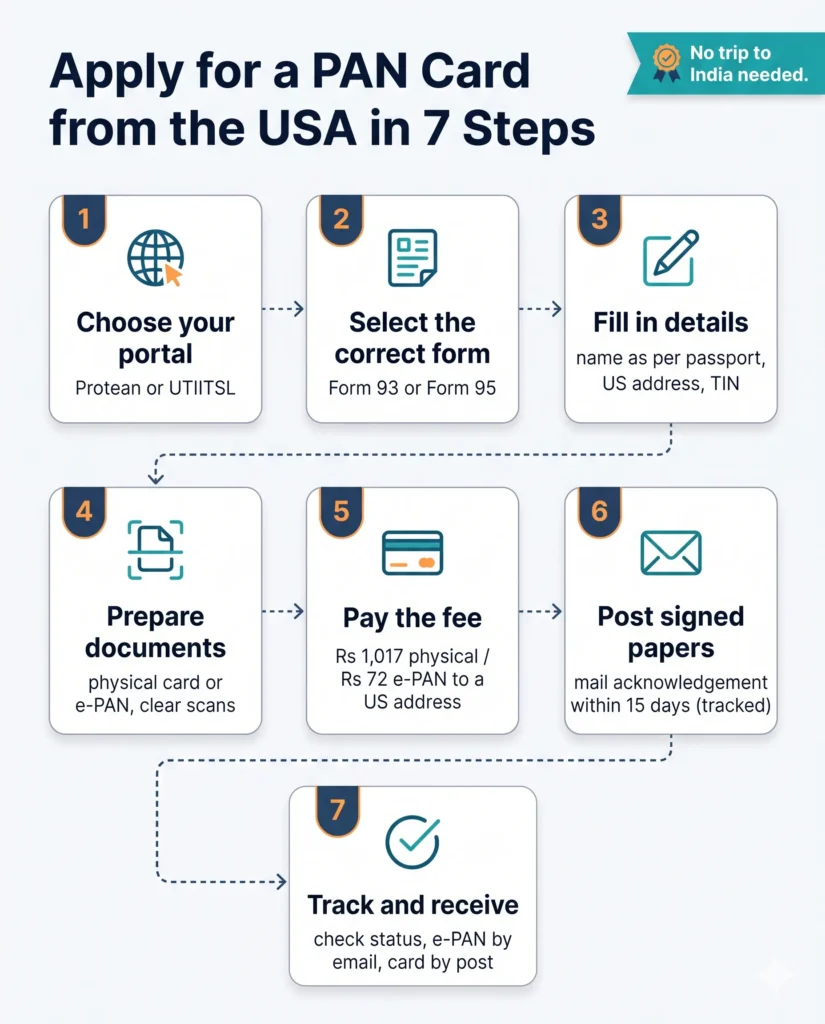
A PAN card application for NRIs goes through only two agencies authorised by the Income Tax Department: Protean eGov Technologies (formerly NSDL) and UTIITSL. The steps are near-identical on both.
- Choose your portal. Pick Protean or UTIITSL and stay with it, because you will track the application on the same site.
- Select the correct form. Choose the new-PAN option for Form 93 (Indian citizens) or Form 95 (foreign citizens).
- Fill in your personal and contact details. Enter your name exactly as on your passport and your US residence address. A mobile number and email are mandatory. Add your passport number and TIN, and if you’re unsure of your AO code, use the department’s Know Your AO tool.
- Choose your card type and prepare documents. Select a physical card or e-PAN only, then scan your documents clearly. Keep originals handy.
- Pay the fee. The fee is charged in rupees: ₹1,017 for a physical card sent to a US address. Cards are the usual route. If a US-issued card is declined, a demand draft is the documented alternative.
- Submit and note your acknowledgement number. Print the acknowledgement, sign it, attach your photo and post it with your document copies to the address printed on it. Older guidance says it must arrive within 15 days of online submission, so use a tracked courier.
- Track the application and receive your PAN. Enter the acknowledgement number on the Protean or UTIITSL status page. An e-PAN arrives by email, and a physical card follows by post.
Why most US applicants post papers. The department also offers a paperless route with lower fees, but it relies on Aadhaar-based e-KYC, e-Sign, or a digital signature certificate. Most US-based applicants don’t have those, so plan on the paper route. Where the portals differ in screen labels or upload limits, follow the on-screen prompts.
Fees, Processing Time, and Delivery to the USA
The fee depends on where the physical card is sent and whether you file on paper or paperless. These figures come from the Income Tax Department’s PAN page, last updated 17 April 2026, and include taxes.
| Item | Within India | Dispatch to USA |
| Physical card, paper route | ₹107 | ₹1,017 |
| e-PAN only, paper route | ₹72 | ₹72 |
| Physical card, paperless route | ₹101 | ₹1,011 |
| e-PAN only, paperless route | ₹66 | ₹66 |
| e-PAN timeline | Faster than the physical card; no official figure | Emailed once the PAN is allotted |
| Physical card timeline | Published guides estimate 15 to 20 working days | Same estimate, plus international post |
The paperless route adds a ₹5.90 e-sign charge. Timelines are estimates from published guides such as Paisabazaar’s NRI PAN guide, not departmental commitments.
For a US applicant the physical card costs about 14 times the e-PAN, roughly US$11 to $12 against under a dollar, depending on the exchange rate. If you only need the number to file returns, invest or open an account, e-PAN only is cheaper. Choose the physical card if your bank or broker insists on one. The US is on Protean’s list of 105 countries where physical cards are dispatched.
Plan on the clock starting when your papers reach the processing centre, not when you click Submit. An incomplete file is treated as invalid and must be refiled.
Common Mistakes and When to Get Help
These errors cause most rejections. The department treats a deficient application as invalid, and edits aren’t allowed after final submission, so you refile from scratch.
- Wrong form. Form 93 for Indian passport holders, Form 95 for everyone else.
- Name mismatches between your passport, bank statement and form.
- Address proof that is older than three months or doesn’t match the address you entered.
- Missing mandatory fields, such as passport number, TIN or mobile number.
- Aadhaar as proof of birth, which is no longer accepted.
- Unclear scans or a photo in the old 5 cm x 2.5 cm size.
- An outdated mailing address copied from an old blog. Use the address printed on your own acknowledgement.
Applicants working across US time zones also hit failed card payments and file-format rejections, with nobody to call at 2 a.m. If you want it filed once and correctly, NRI Hub’s team can review your documents and file on your behalf.
Applying for a PAN card from the USA is straightforward once you know the 2026 rules: you fill the form online, post your papers, and wait for the card. The form you choose and the quality of your documents decide whether you’re approved. Most applicants can manage it in one sitting with a passport, a recent US bank statement, and their TIN to hand.
Frequently Asked Questions
Yes. You complete the application online and post the signed acknowledgement and document copies to the processing centre. No trip to India is needed.
Published guides estimate 15 to 20 working days once your documents are verified, plus international post. The department doesn’t publish a guaranteed timeline.
An e-PAN is a PDF sent to your email. A physical card is posted to you. On the paper route the e-PAN costs ₹72 and the physical card ₹1,017 for a US address.
Yes, using Form 95. You will need a TIN (typically your SSN or ITIN) and proof of date of birth.
Your PAN number stays the same for life, but your address and residential status should be updated through the change or correction form. If you hold Aadhaar, link it to your PAN.
No. PAN is a tax ID; Aadhaar is a separate 12-digit identity number. NRIs aren’t obliged to get Aadhaar, but those without it should update their residential status as non-resident on the e-filing portal, or the PAN can be marked inoperative.




No Comment! Be the first one.