




Foreign Tax Credit Limitation: How It Works for India Income
The foreign tax credit limitation caps your US credit at the US tax attributable to foreign-source taxable income in each category. Multiply US tax before credits by foreign-source taxable income divided by worldwide taxable income. Eligible excess Indian tax may carry to another year, not create a refund.


Your Indian bank withheld ₹2,40,000 in TDS from NRO fixed deposit interest. You report that interest on your US return, yet the credit comes out smaller than the amount India collected.
Table Of Content
- What the Foreign Tax Credit Limitation Actually Caps
- Working the Limit on India Income: A Worked Example
- Why Your India Income Splits Into Separate Baskets
- Where the US-India Tax Treaty Changes the Math
- Foreign Tax Credit vs Deduction on Indian Taxes
- When You Can Elect Not to File Form 1116
- Four India-Specific Traps That Shrink the Credit
- Conclusion and next step
- Frequently Asked Questions
- Is there a dollar limit on the foreign tax credit?+
- Can I claim a foreign tax credit for TDS deducted in India?+
- What happens to Indian tax I cannot claim this year?+
- Do I need a separate Form 1116 for my India income?+
The difference is the foreign tax credit limitation, not a fixed dollar ceiling. It depends on your US income tax and the share of taxable income sourced outside the United States.
Below, $3,000 of Indian tax becomes a $2,000 credit. NRO interest and Indian salary also get separate limits.
What the Foreign Tax Credit Limitation Actually Caps
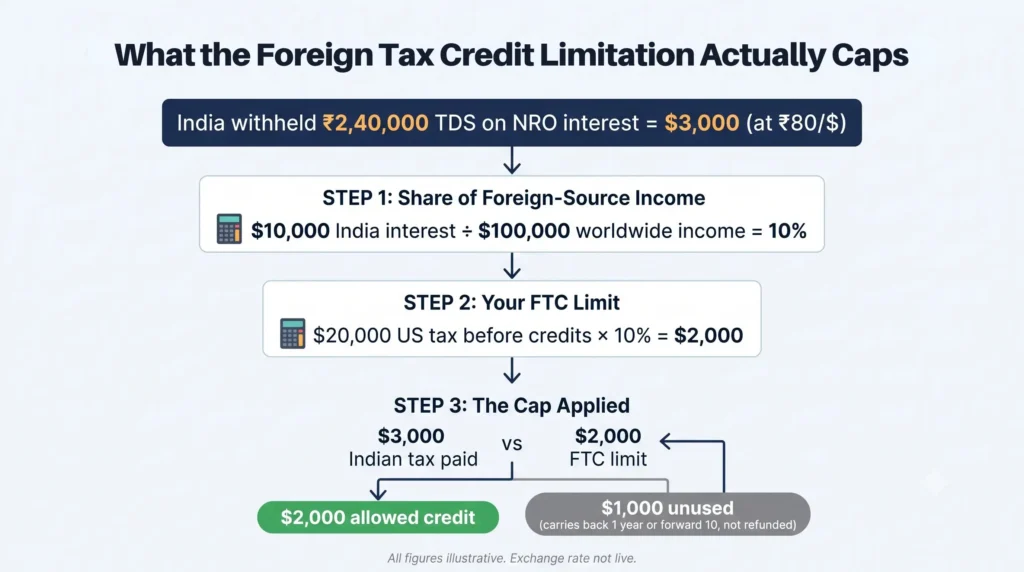
Indian income tax generally cannot offset the US tax attributable to your US-source income.
FTC limit = US tax before credits × (foreign-source taxable income in the category ÷ worldwide taxable income)
You generally claim whichever is lower: the qualified Indian tax paid or accrued, or the foreign tax credit limit calculated for that category.
If India collected $3,000 but your limit is $2,000, you can generally use $2,000. The unused $1,000 is not refundable.
These are taxable income figures under US rules. Allocated deductions and adjustments can change the formula. You also calculate the limit separately for each relevant category.
Eligible excess foreign income tax can generally be carried back one year or forward ten years, within the same category. You can read the IRS carryover rules in Publication 514. Carryovers need available limitation in another eligible year.
Working the Limit on India Income: A Worked Example
Suppose you live in the United States, earn a US salary and receive NRO fixed deposit interest from India. Your bank withheld ₹2,40,000 of Indian income tax that qualifies for the credit.
Assume foreign-source passive interest and taxable income after necessary US adjustments. All figures are illustrative.
| Line | Amount (USD) |
| Worldwide taxable income | $100,000 |
| India-source taxable NRO interest | $10,000 |
| US income tax before credits | $20,000 |
| Indian tax: ₹2,40,000 ÷ 80 | $3,000 |
| Calculated FTC limit | $2,000 |
| Allowed foreign tax credit | $2,000 |
| Unused Indian tax | $1,000 |
Step 1: $10,000 ÷ $100,000 = 10% foreign-source taxable income.
Step 2: $20,000 × 10% = $2,000 foreign tax credit limit.
Step 3: Compare $2,000 with $3,000 of eligible Indian tax.
Allowed credit: $2,000. Unused tax: $1,000. The excess may qualify for a carryback or carryforward.
The assumed exchange rate of ₹80 per dollar is not a live rate. For taxes credited on a paid basis, use the exchange rate when the tax was paid or withheld. Check your NRO interest statement, Form 16A and Indian tax records against the US return figures. The IRS Form 1116 instructions explain how to complete the actual calculation.
Why Your India Income Splits Into Separate Baskets
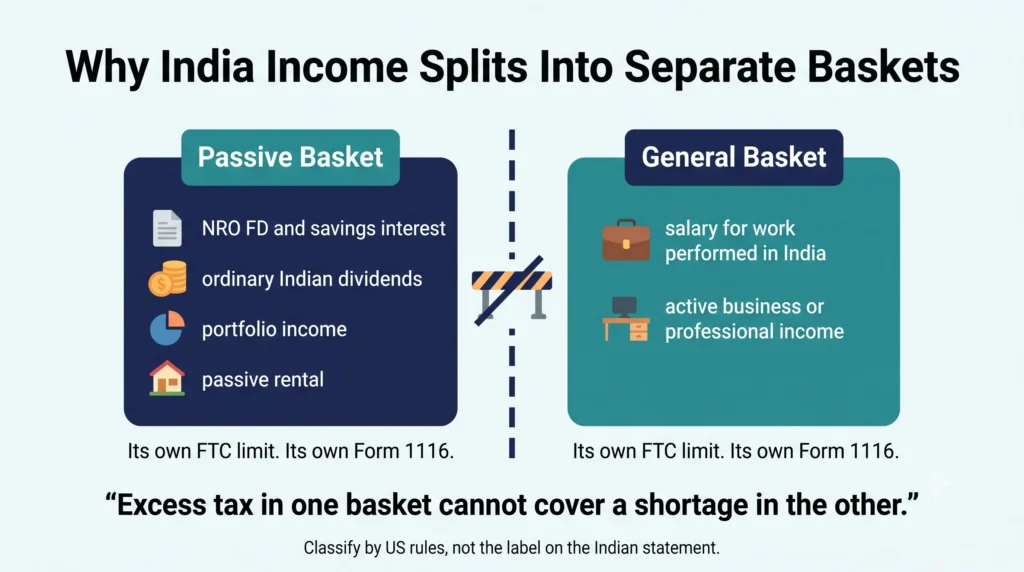
The IRS does not generally let you combine the tax on NRO interest with the tax on salary earned while working in India. It calculates separate limits for different income categories, called baskets.
Passive category: Usually includes NRO fixed deposit and savings interest, ordinary Indian dividends, portfolio income and passive rental income.
General category: Usually includes salary for services performed in India and certain active business or professional income.
Exceptions include high-taxed passive income and active rents. Classify the income using US rules rather than the label on an Indian statement.
Suppose you received $8,000 in NRO interest and $30,000 in pay for work performed in India. The interest generally belongs in the passive basket; the salary generally belongs in general.
You ordinarily calculate a separate limit and Form 1116 for each. Excess passive-category tax cannot cover a shortage in the general category. That is why a large total US tax bill may still leave little room for credit on NRO interest.
Where the US-India Tax Treaty Changes the Math
The US-India tax treaty matters because it can change the Indian tax you legally owe, not because every rupee of Indian TDS automatically qualifies for a US credit. Eligibility depends on treaty residence, income type and other conditions, including the saving clause for US citizens.
Article 25 addresses relief from double taxation. Article 10 deals with dividends, while Article 11 covers interest. For eligible treaty residents, the interest and dividend provisions may restrict India’s source-country tax. Don’t assume a reduced rate applies without checking the actual treaty conditions.
If an Indian bank withheld more tax than India can legally collect, that excess is generally refundable in India, not creditable in the US. Check the final Indian liability before using TDS on Form 1116.
Article 25 may also allow certain income to be treated as foreign-source for double-taxation relief. That treaty re-sourcing can require a separate Form 1116 category. Some treaty-based return positions require Form 8833, although exceptions apply.
Read Articles 10, 11 and 25 in the official treaty. For residence and withholding questions, use a dedicated guide to how the US-India tax treaty allocates taxing rights.
Foreign Tax Credit vs Deduction on Indian Taxes
A credit reduces eligible US income tax directly. A deduction reduces taxable income, so the savings depend on your tax rate and whether you itemise.
| Factor | Foreign tax credit | Foreign tax deduction |
| Reduces | US income tax | Taxable income |
| Value | Dollar-for-dollar, up to the limit | Depends on your tax rate |
| Filing method | Usually Form 1116 | Generally Schedule A |
| Main restriction | Foreign-income limitation | Must qualify and itemize |
| Unused amounts | Eligible excess can carry over | No equivalent FTC carryover |
Suppose you paid $1,000 of qualifying Indian tax. A fully usable credit cuts US tax by $1,000. If a $1,000 additional itemized deduction reduces taxable income at an illustrative 22% marginal rate, it saves about $220.
The credit usually saves more. If the limit blocks most of it and you itemize, compare both.
You generally must choose a credit or deduction for all qualified foreign taxes for that year. The choice can be changed within statutory deadlines: generally ten years for changing a deduction to a credit, with different refund-claim deadlines in the other direction. See IRS Publication 514 for the exceptions.
When You Can Elect Not to File Form 1116
You may be able to elect not to file Form 1116 when all these conditions hold:
- Your only foreign-source gross income is qualifying passive income, such as interest or dividends.
- Qualified foreign taxes total no more than $300, or $600 if married filing jointly.
- All the foreign income and related taxes are reported on qualified payee statements, including eligible Forms 1099 or qualifying substitute statements.
The foreign taxes must still meet creditability rules, and estates and trusts cannot use this election.
Small NRO withholding alone does not establish eligibility. Form 16A, Form 26AS or an Indian bank statement is not automatically a qualified payee statement.
Eligible individuals enter the credit on Schedule 3 (Form 1040), line 1. They cannot carry unused taxes to or from an election year. Check IRS Topic 856 for the detailed tests.
Four India-Specific Traps That Shrink the Credit
1. India’s financial year differs from the US calendar year. India generally uses April through March; US individuals normally report January through December. Don’t copy an entire Indian financial-year TDS total into one US return. Check dates and apply your chosen paid or accrued credit method.
2. TDS isn’t always the final Indian tax. A bank may withhold more than India legally requires. Refundable excess generally isn’t creditable. If India later refunds tax that supported a US credit, a foreign tax redetermination may be needed under IRS Publication 514.
3. Exchange rates change the US-dollar amount. For paid-basis credits, generally use the rate on the withholding or payment date. Accrued taxes have separate translation rules. Keep the rupee amount, date, exchange rate and calculated dollar amount for each payment.
4. Indian records can disagree. Reconcile NRO statements and Form 16A with Form 26AS, AIS, tax challans and refund records. Look for duplicate entries, refunded taxes and different payment dates. Keep the documents supporting the amount reported on Form 1116.
Conclusion and next step
Indian tax withheld isn’t automatically your allowed US foreign tax credit. You generally claim the lower of qualified Indian tax and the US limit for the relevant basket.
Before filing, match NRO income and TDS to the correct year, determine the final Indian tax owed, convert qualified tax into dollars and review each Form 1116 category.
Use a Form 1116 walkthrough to check the entries. If you have treaty claims, Indian refunds or several income categories, consider consulting a qualified US-India tax professional.
Frequently Asked Questions
There is no single dollar ceiling for the regular credit. Your limit depends on US tax and foreign-source taxable income in the applicable category. The separate 300/600 thresholds concern the simplified election for eligible taxpayers who can claim a credit without filing Form 1116.
Yes, if the withholding is qualifying Indian income tax you legally owe and meets US creditability requirements. TDS alone doesn’t prove that every rupee qualifies. Refundable overpayments generally aren’t creditable, and qualifying tax is still subject to the applicable US credit limit.
Eligible unused foreign income taxes generally carry back one year or forward ten years. They stay in the relevant income category and can be used only when another eligible year has enough unused limitation. The simplified election prevents carrying tax to or from that election year.
Usually, file a separate Form 1116 for each applicable category. NRO interest and ordinary Indian dividends generally fall into passive income; pay for work performed in India generally falls into general income. High-taxed passive income, certain businesses and treaty-sourced income can change that classification.






No Comment! Be the first one.