




TDS Rate When Buying Property from an NRI
For an individual NRI seller, the usual base TDS rate is 12.5% on long-term property gains or generally 30% for short-term gains, plus applicable surcharge and 4% cess. Without an authorised lower deduction or taxable-portion determination, buyers commonly deduct on the full payment. A certificate can change the rate or amount subject to deduction.


Buying a flat from an NRI? If you deduct too little TDS, the Income Tax Department can hold you responsible for the shortfall, even after you’ve paid the seller.
Table Of Content
- Why Does TDS Apply When Buying Property From an NRI?
- What Is the TDS Rate on Property Purchase From NRI (Including Surcharge and Cess)?
- Surcharge on TDS for NRI
- Is TDS Deducted on the Full Sale Price or Only the Capital Gain?
- How Can an NRI Seller Get a Lower or Nil TDS Certificate (Form 128)?
- Does the Buyer Need a TAN to Deduct TDS?
- What Are the Due Dates for Depositing and Filing TDS (Form 145)?
- What Happens If the Buyer Fails to Deduct TDS?
- Can a DTAA Reduce the TDS Rate for an NRI Seller?
- How Does the NRI Seller Repatriate the Sale Proceeds Abroad?
- Conclusion
- Is TDS on NRI property purchase 1% like it is for resident sellers?+
- Who is responsible if TDS is deducted at the wrong rate, the buyer or the seller?+
- Can the buyer deduct TDS without a TAN?+
- Does TDS apply if the NRI seller’s total gain is below the basic exemption limit?+
The TDS rate on property purchase from NRI sellers depends on how long they’ve owned the property, applicable surcharge and cess, and whether a tax certificate allows a lower deduction.
There is also a major change from October 1, 2026: certain individual buyers no longer need a TAN.
Here’s how to calculate the deduction, avoid withholding more than necessary and complete the correct paperwork before and after payment.
Quick Answer
For an individual NRI seller, the usual base TDS rate is 12.5% on long-term property gains or generally 30% for short-term gains, plus applicable surcharge and 4% cess. Without an authorised lower deduction or taxable-portion determination, buyers commonly deduct on the full payment. A certificate can change the rate or amount subject to deduction.
Why Does TDS Apply When Buying Property From an NRI?
When you pay a nonresident seller for property in India, you’re responsible for deducting tax from amounts chargeable under Indian income-tax law.
Since April 1, 2026, the governing provision is Section 393(2) of the Income-tax Act, 2025, formerly Section 195 of the 1961 Act.
The buyer deducts and deposits the tax. The seller is responsible for their eventual income-tax return, but that doesn’t transfer your withholding responsibility to them.
The timing matters too. TDS can become due when you credit or pay the seller, whichever happens earlier. That means an advance payment may need withholding before registration.
Before transferring money, confirm the seller’s tax-residential status. Indian citizenship, an Indian address, or ownership of Indian property doesn’t by itself prove the seller is an Indian tax resident.
What Is the TDS Rate on Property Purchase From NRI (Including Surcharge and Cess)?
For immovable property, a holding period exceeding 24 months generally produces a long-term gain. A holding period of 24 months or less normally produces a short-term gain.
The following rates illustrate withholding for an individual NRI seller under the general domestic provisions.
| Holding period | Base TDS rate | Illustrative surcharge | Cess | Effective rate |
| Over 24 months | 12.5% | Nil | 4% | 13.00% |
| Over 24 months | 12.5% | 10% of tax | 4% | 14.30% |
| Over 24 months | 12.5% | 15% of tax | 4% | 14.95% |
| 24 months or less | Generally 30% | Nil in this example | 4% | 31.20% |
Rates are illustrations before any authorised certificate or other applicable adjustment. The correct treatment depends on the seller’s status, income and relevant tax provisions.
Surcharge on TDS for NRI
Surcharge is calculated on the income tax, not directly on the property price.
For individuals, the usual bands relevant to these examples are:
- Taxable income up to ₹50 lakh: no surcharge.
- Above ₹50 lakh and up to ₹1 crore: generally 10%.
- Above ₹1 crore: generally 15% for the relevant long-term capital gains.
A 4% health and education cess applies to the tax plus surcharge.
The surcharge on TDS for NRI sellers cannot be determined simply by looking at the sale price. Other income, the type of gain and the applicable provisions matter.
If the seller doesn’t provide a valid PAN, higher withholding rules may apply. Under Section 397(2), the applicable deduction can be the highest of the prescribed rate, the rate in force or 20%.
Have the seller’s CA confirm the correct rate before calculating the payment.
Is TDS Deducted on the Full Sale Price or Only the Capital Gain?
Suppose you’re buying an NRI-owned flat for ₹1 crore. The seller originally paid ₹65 lakh.
You might expect to deduct TDS only on the apparent ₹35 lakh gain.
But buyers shouldn’t simply subtract the purchase cost and choose their own withholding base.
Although the law concerns sums chargeable to tax, without an accepted determination or lower-deduction certificate, buyers commonly withhold on the full sale consideration to avoid under-deduction.
Here’s what that can mean.
| Illustration | Amount |
| Sale consideration | ₹1,00,00,000 |
| Assumed long-term effective TDS rate, without surcharge | 13% |
| TDS on full consideration | ₹13,00,000 |
| Amount paid to seller after withholding | ₹87,00,000 |
Now suppose the tax authority authorises a taxable portion of ₹35 lakh and the applicable deduction on that portion is 13%. The illustrative withholding would be ₹4.55 lakh instead.
That’s a difference of ₹8.45 lakh in money withheld at the time of sale.
The seller’s final capital gain may differ from ₹35 lakh because of permitted costs, valuation rules and exemptions. These examples aren’t substitutes for the actual certificate.
The key rule: don’t reduce the withholding base using your own capital-gains calculation. Get the appropriate determination or certificate first.
How Can an NRI Seller Get a Lower or Nil TDS Certificate (Form 128)?
If full-price withholding would be excessive, address it before making the payment.
The seller can apply for a lower or nil deduction certificate using Form 128 under Section 395(1). This replaces the old Form 13 procedure.
They generally need their PAN, sale agreement, purchase documents, estimated gains and supporting tax calculations.
The Assessing Officer reviews the application. If a certificate is issued, you follow its specified rate and conditions for the covered payment.
A buyer can also apply under Section 395(2) using Form 129 to establish what portion of the payment is chargeable to tax. This replaces the earlier Form 15E application.
These forms do different jobs:
| Form | Who applies? | Purpose |
| Form 128 | Seller | Lower or nil deduction rate |
| Form 129 | Buyer or payer | Determine taxable portion of the payment |
Processing times vary. Start early rather than assuming approval will arrive before registration.
A pending application isn’t permission to deduct less. Follow the approved certificate only after it has been issued and checked.
See the Income Tax Department’s 2026 form guidance.
Does the Buyer Need a TAN to Deduct TDS?
Not always. The rule changed on October 1, 2026.
A resident individual or Hindu Undivided Family (HUF) buying immovable property from a nonresident can now use Form 141, Schedule E, through their PAN login. They don’t need a TAN solely for this transaction.
Companies and other buyers outside this facility generally continue with TAN-based compliance.
| Buyer | TAN for this transaction? | Reporting route |
| Resident individual | No, under the new procedure | Form 141, Schedule E |
| Resident HUF | No, under the new procedure | Form 141, Schedule E |
| Company or other ineligible buyer | Generally yes | TAN-based TDS statement |
This is different from the older procedure, which required individual buyers to obtain a TAN when buying from an NRI.
The Income Tax Department’s Form 141 instructions explain who can use the PAN-based system.
What Are the Due Dates for Depositing and Filing TDS (Form 145)?
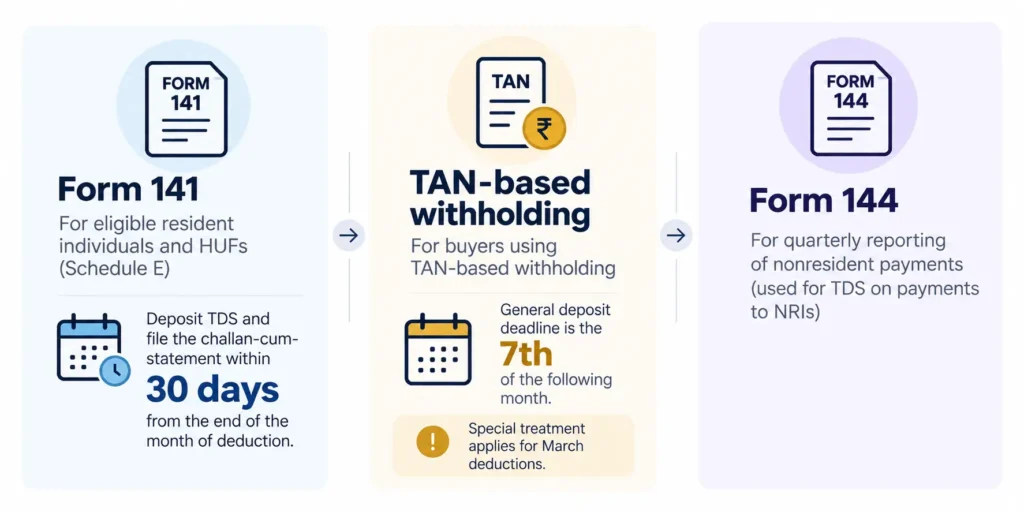
Your deadlines depend on which filing route applies.
For eligible resident individuals and HUFs using Form 141, Schedule E: Deposit the TDS and file the challan-cum-statement within 30 days from the end of the month of deduction.
For example, if you deduct tax on October 20, 2026, the payment and Form 141 filing are due by November 30, 2026.
For buyers using TAN-based withholding: The general deposit deadline is the 7th of the following month, with special treatment for March deductions.
Quarterly reporting for nonresident payments uses Form 144, which replaces Form 27Q.
| Quarter | Period | General quarterly statement deadline |
| Q1 | April-June | July 31 |
| Q2 | July-September | October 31 |
| Q3 | October-December | January 31 |
| Q4 | January-March | May 31 |
Form 145 isn’t the quarterly TDS return. It replaces Form 15CA for applicable remittance reporting. Form 146 replaces the corresponding CA certificate, Form 15CB.
The seller’s later transfer of sale proceeds abroad doesn’t automatically make you responsible for those remittance filings.
After filing, keep the payment confirmation and provide the applicable TDS certificate to the seller. For Form 141, the certificate can be downloaded through TRACES.
What Happens If the Buyer Fails to Deduct TDS?
If you don’t deduct the required tax, the Income Tax Department may treat you as an assessee in default and seek the shortfall, subject to statutory relief.
Interest can apply to tax that wasn’t deducted on time or was deducted but deposited late.
Additional penalties may arise, and serious failures involving nonpayment of deducted tax can have further consequences.
Some business transactions may also face restrictions on claiming expenses, although that isn’t an automatic consequence for an individual buying a home.
The seller moving overseas doesn’t remove your liability.
Keep proof of the seller’s status, the applicable rate, any certificate, the tax payment and the TDS filing. If the seller later disputes the deduction, you’ll have a record showing how the figure was reached.
Can a DTAA Reduce the TDS Rate for an NRI Seller?
A Double Taxation Avoidance Agreement (DTAA) can change the tax treatment of some payments to nonresidents.
But don’t assume an Indian property sale qualifies for a lower treaty rate.
Most treaties allow India to tax gains from immovable property located in India. Domestic withholding rules therefore often remain relevant.
Where a treaty benefit genuinely applies, the seller may need a Tax Residency Certificate and supporting documents.
Ask a cross-border tax adviser to check the specific treaty before reducing withholding.
How Does the NRI Seller Repatriate the Sale Proceeds Abroad?
Once the sale is complete, the NRI seller may want to transfer the money overseas.
Under RBI rules, eligible NRIs and OCIs can generally remit up to US$1 million per Indian financial year from qualifying NRO funds and asset-sale proceeds, subject to documentation and tax compliance.
The seller and their authorised dealer bank normally handle this process.
The bank may request the sale deed, evidence of taxes paid and applicable declarations.
This overseas transfer is separate from your responsibility to deduct and deposit TDS on the property purchase.
See the RBI guidance on remittance of assets.
Conclusion
The TDS rate depends on how long the NRI seller owned the property, the applicable surcharge and cess, and any valid tax certificate.
The bigger issue for buyers is knowing how much of the payment to withhold. Don’t assume that only the seller’s estimated capital gain is subject to deduction without proper authorisation.
Before transferring an advance, check the seller’s tax status, confirm the withholding rate and establish whether Form 128 or Form 129 is needed.
Then follow the correct filing route for your buyer category. Getting those details right before payment can prevent a costly correction later.
No. The 1% property-purchase TDS rule applies to qualifying resident-seller transactions.For an NRI seller, withholding generally follows the nonresident payment provisions. Long-term gains usually have a 12.5% base rate, while short-term gains generally attract a higher rate for an individual seller, with applicable surcharge and cess.
The buyer is responsible for deducting and depositing the correct TDS.The seller remains responsible for their final income-tax liability, but that doesn’t automatically remove the buyer’s withholding responsibility. If too little tax was deducted, the buyer may face recovery of the shortfall, interest and other consequences, subject to available legal relief
Yes, if the buyer qualifies under the new procedure effective October 1, 2026.A resident individual or HUF buying immovable property from a nonresident can generally use Form 141, Schedule E, through a PAN login without obtaining a TAN solely for that purchase.Companies and other buyers outside the facility generally need TAN-based compliance
Don’t assume that a small gain automatically removes the withholding obligation.The result depends on the seller’s tax status, the gain’s nature and the applicable withholding rules.If the seller expects little or no final tax liability, they can seek a lower or nil deduction certificate. As the buyer, follow the approved rate rather than an informal estimate.





No Comment! Be the first one.